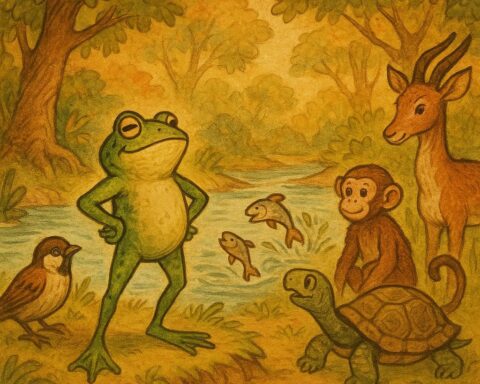
Deep in the forests of Gabon, Leopard was the most feared hunter. His leaps were swift, and his claws were sharp. All animals whispered his name except for Monkey, who loved to tease.
One day, Leopard hunted from morning until evening but caught nothing. Tired and hungry, he lay beneath a tree. Monkey, watching from above, laughed.
“Ha! Mighty Leopard, where is your dinner? Your whiskers carry only dust!”
Leopard growled. “Careful, Monkey. My claws are sharper than your words.”
But Monkey only laughed louder. “What use are claws when they catch no meat?”
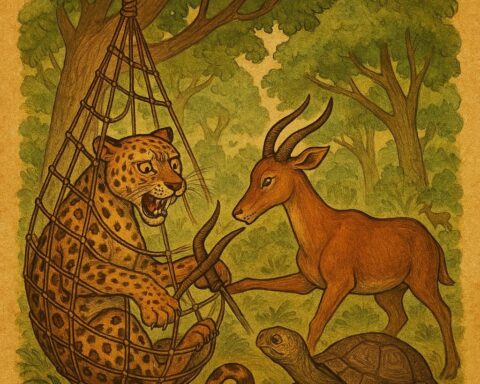
Angry, Leopard planned a trick. The next day he lay beside a dead animal, pretending to be lifeless. “When Monkey comes close, I will pounce,” he thought.
Monkey soon arrived. From the branches, he whispered, “If Leopard is truly dead, he won’t move.” He dropped a twig onto Leopard’s ear. No movement. He tossed a fruit onto Leopard’s nose. Still no movement.
“Very well,” Monkey said, “then I shall dance above the mighty hunter!” He shook the branches. Leaves rained down. Leopard could not hold back. With a roar, he leapt up.
But Monkey was ready. Quick as lightning, he bounded away, his laughter echoing through the trees.
And so the animals learned: mocking brings danger, and pride can turn the strong into fools.
Moral of the Story
Mocking others can cause trouble, and pride often leads to foolish mistakes.
Word Helper
- Whiskers – long hairs on an animal’s face.
- Canopy – the tops of trees that form a roof in the forest.
- Pounce – to jump suddenly on something.
- Twig – a small thin branch from a tree.
- Arrogance – when someone acts too proud or full of themselves.
Summary for Parents/Teachers
“Why Monkey Mocked Leopard” is a lively folktale from Gabon, in Central Africa. It features two animals common in African storytelling: the trickster Monkey and the proud Leopard. Folktales often use animals to represent human traits. Monkey shows cleverness mixed with mischief, while Leopard shows strength mixed with pride.
The story highlights two important lessons for children. First, mocking others can invite danger. Monkey’s laughter could have cost him his safety, and children learn that teasing others is unkind and often risky. Second, pride and anger can blind us. Leopard, who was once feared by all, became the fool because his anger clouded his judgment. These themes can spark meaningful discussions about respect, humility, and wise decision-making.
Teachers and parents can use this story in multiple ways. In a classroom, it can be tied to lessons about African culture, animal habitats, or values such as respect and self-control. Parents can use it at home to guide children toward kindness, showing that laughter should bring joy, not harm.
The cultural context is also valuable. Storytelling is central to Gabonese and broader African traditions. Around fires at night, elders would tell such tales not only to entertain but also to teach social values. Monkey and Leopard are recurring figures in African folklore, symbolizing wit versus power. Their conflict mirrors real-life struggles between cleverness and strength.
Overall, this folktale encourages children to think carefully before speaking and reminds adults that pride can undo even the strongest.
Discussion Time
Want to discuss this with your child? Here are some questions:
- Why did Monkey mock Leopard, and what almost happened to him because of it?
- What mistake did Leopard make when he tried to trick Monkey?
- What do you think the forest animals learned from watching this story?
- Can you think of a time when pride or teasing caused problems in real life?
Classroom Activity
Roleplay the Forest Scene – Divide students into small groups. One student plays Leopard, another plays Monkey, and the rest play forest animals watching. Act out the hunting, the trick, and Monkey’s escape. Afterward, discuss what the class learned about respect and pride.